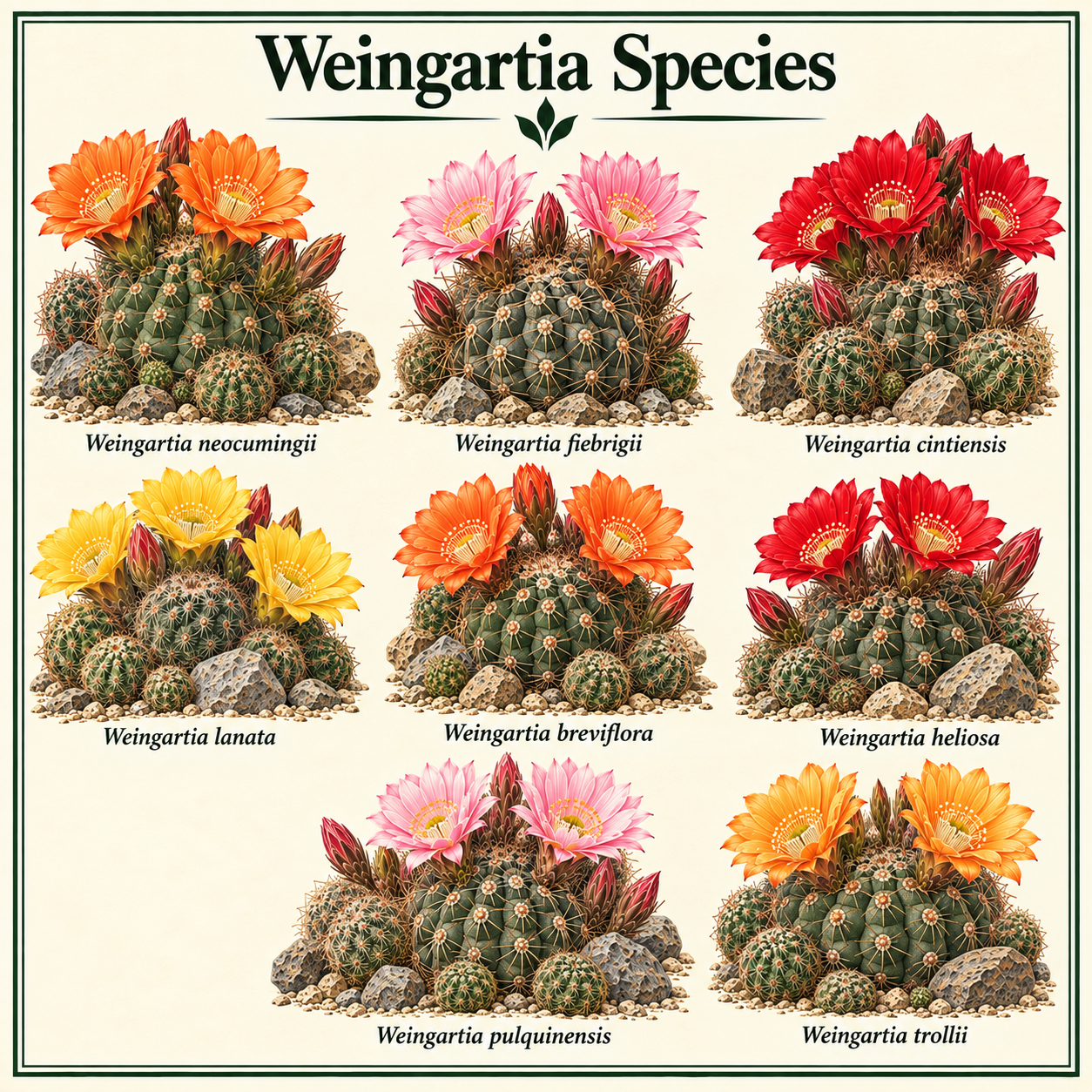

Weingartia Species
Compact Cacti. Alpine Character. Flowers That Refuse to Stay Small.
This Weingartia Species Seed Mix produces small globular cacti known for their attractive spines, compact growth, and brilliantly colorful flowers. Weingartia species belong to the Cactaceae family and are native to high-altitude regions of Bolivia and Argentina, where they inhabit rocky mountain environments with strong light, sharp drainage, and pronounced seasonal conditions.
Plants typically develop solitary or slowly clustering globular stems covered in fine to prominent spines that can vary from white and yellow to brown and nearly black. Their compact growth makes them excellent candidates for small containers and collector displays. During the growing season, mature plants can produce vibrant flowers in shades of yellow, orange, red, and pink—often creating a dramatic display around the crown.
Their miniature stature, mountain origins, variable spination, and oversized flowers make Weingartia especially appealing to collectors interested in compact and alpine-type cacti.
Family: Cactaceae
Genus: Weingartia
Native Range: Bolivia & Argentina
Growth Habit: Small globular cactus; solitary to slowly clustering
Light: Bright light to full sun
Water: Low; allow substrate to dry between waterings
Plant Care
• Grow in a highly porous, well-draining cactus substrate
• Provide bright light to encourage compact growth, strong spination, and flowering
• Gradually acclimate plants to intense direct sunlight
• Allow the growing medium to dry substantially between waterings
• Water during active growth without allowing the roots to remain continuously wet
• Excellent drainage is especially important for preventing root problems
• Provide good airflow around plants
• A cooler, drier winter rest is beneficial for many plants in this group
• Reduce watering considerably during cool or dormant periods
• Small containers can suit their naturally compact growth, provided drainage is excellent
Germination Instructions
• Sow seeds on the surface of a fine, well-draining cactus seed-starting medium
• Gently press seeds against the surface and cover only very lightly, if at all
• Provide warm temperatures for germination
• Keep the substrate evenly moist during germination, but never waterlogged
• Provide bright, filtered light rather than intense direct sun for newly germinating seedlings
• Gentle humidity helps prevent the seed-starting medium from drying too quickly
• Avoid excessive moisture and stagnant conditions
• Do not allow very young seedlings to completely dry out
• Gradually increase airflow as seedlings become established
• Slowly introduce stronger light as young plants develop
• Transplant carefully once seedlings are sufficiently established to handle
Interesting Facts
• Weingartia species are famous for producing large, brilliantly colored flowers despite their small size.
• Flowers commonly appear in shades of yellow, orange, red, and pink, often emerging near the crown.
• Spine coloration can vary considerably, including white, yellow, tan, brown, gray, and nearly black.
• Plants may remain solitary or gradually form attractive clusters as they mature.
• Many Weingartia originate from high-altitude Andean environments, giving the group its distinctive alpine character.
• Their compact size makes them particularly useful for collectors who want to maintain greater species diversity in limited growing space.
• Seed-grown plants can reveal differences in body shape, spine density, spine coloration, clustering habit, and flower characteristics.
• Weingartia has a complicated botanical relationship with Rebutia and Sulcorebutia, and species within these groups have been reclassified under different taxonomic treatments.
• Because of this changing classification, the same or closely related plants may be encountered under Weingartia, Sulcorebutia, or Rebutia names in botanical collections and older references.
• Their combination of miniature growth, mountain adaptations, dramatic spines, and disproportionately large flowers has made them longtime favorites among specialist cactus collectors.
Please Note
This is a mixed Weingartia species seed assortment. Species, seed quantities, mature sizes, body forms, spine characteristics, coloration, clustering habits, flower colors, growth rates, and other traits may vary. Due to the complex taxonomic relationship between Weingartia, Sulcorebutia, and Rebutia, individual plants may also be encountered under different botanical names depending on the classification system used. Specific species and germination results are not guaranteed.
Small enough for the windowsill. Wild enough for the Andes. Compact bodies. Brilliant blooms.