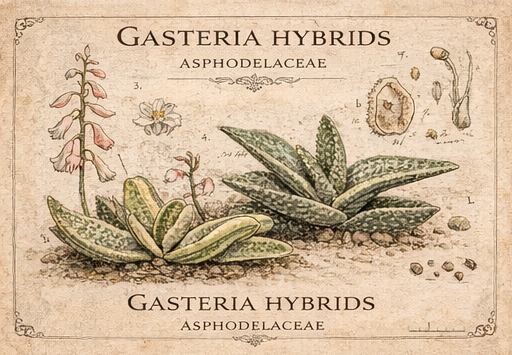

Gasteria Hybrid Mix
Spotted Leaves. Sculptural Forms. Every Seedling is a Surprise.
This Gasteria Hybrid Seed Mix produces compact succulents known for their thick leaves, distinctive spotting, unusual textures, and diverse hybrid forms. Gasteria belongs to the Asphodelaceae family and originates from South Africa, where species have evolved an impressive range of leaf shapes, markings, and growth habits.
Hybrids are especially prized by collectors because each seedling can reveal a different combination of inherited characteristics. Leaves may be smooth or heavily textured, narrow or broad, spotted, banded, mottled, or covered with raised markings. Their compact growth, adaptability, and tolerance of bright filtered light also make Gasteria excellent candidates for windowsills, small containers, and succulent collections.
Family: Asphodelaceae
Genus: Gasteria
Parentage: Hybrid Gasteria
Native Ancestry: South Africa
Growth Habit: Compact rosette-forming succulent
Light: Bright indirect light to partial sun
Water: Low; allow substrate to dry between waterings
Plant Care
• Grow established plants in a porous, fast-draining succulent substrate
• Provide bright, filtered light to encourage healthy, compact growth
• Bright indirect light to partial sun generally suits Gasteria well
• Gradually acclimate plants before exposing them to stronger direct sunlight
• Protect plants from prolonged, intense midday sun that may scorch the foliage
• Water thoroughly, then allow the substrate to dry substantially before watering again
• Never leave containers sitting in standing water
• Reduce watering during cooler temperatures or periods of slower growth
• Avoid continuously wet soil, which can encourage root and crown rot
• Provide good airflow around the plants
• Repot when necessary into containers with unrestricted drainage
• Their compact and adaptable growth makes Gasteria particularly well suited to windowsills, shelves, and small-space succulent collections
Germination Instructions
Fill a clean container with a fine, well-draining succulent seed-starting medium.
Moisten the substrate evenly before sowing. It should be damp but not saturated or waterlogged.
Place the seeds across the surface of the substrate and gently press them into place.
Cover the seeds only very lightly with fine substrate. Do not bury them deeply.
Place the container in a warm location with bright, filtered light, avoiding intense direct sun.
Maintain gentle humidity around the seeds to keep the surface from drying too quickly.
Keep the substrate slightly and consistently moist during germination. Do not allow it to become waterlogged.
Provide some airflow to reduce stagnant conditions and discourage mold.
After seedlings emerge, continue providing bright, filtered light and consistent gentle moisture while they establish.
As seedlings become stronger, gradually increase airflow and reduce humidity rather than changing conditions suddenly.
Begin allowing the upper portion of the substrate to dry slightly between waterings as the seedlings mature and develop stronger root systems.
Gradually acclimate established seedlings to normal Gasteria growing conditions.
Transplant carefully once seedlings are large enough to handle without damaging their roots.
Interesting Facts
• Gasteria are named for their unusual flowers. The genus name comes from gaster, meaning “stomach,” referring to the swollen, stomach-like shape of the flowers.
• Gasteria hybrids are particularly prized for unusual combinations of leaf spotting, mottling, texture, shape, thickness, and coloration.
• Leaves can range from relatively smooth to dramatically rough, bumpy, or covered with raised markings.
• Young Gasteria often begin with leaves arranged in two opposing rows before some plants gradually develop a more rosette-like appearance as they mature.
• Hybrid seedlings may produce leaves ranging from narrow and elongated to short, broad, and remarkably chunky.
• Their ability to perform well in bright filtered light makes them especially popular among windowsill succulent growers.
• Mature plants can produce slender flower stalks carrying distinctive tubular flowers, often combining shades of pink, coral, red, orange, green, and cream.
• Gasteria are related to Aloe and Haworthia, members of the same broader succulent lineage.
• Crosses between Gasteria and Aloe have also produced horticultural hybrids commonly known as ×Gasteraloe.
• Although related plants have histories of traditional use, Gasteria itself is cultivated primarily as an ornamental and collector succulent.
• Seed-grown hybrids are genetically unique individuals, so siblings from the same seed batch can develop noticeably different characteristics as they mature.
• Some of the most interesting markings and textures may become increasingly pronounced as the plants age, making hybrid seedlings especially rewarding for long-term collectors.
Please Note
This is a mixed Gasteria hybrid seed assortment. Parentage, seed quantities, mature size, leaf shape, spotting, texture, coloration, growth habit, flower characteristics, growth rate, and other traits may vary. Hybrid seedlings are genetically variable and are not guaranteed to reproduce the exact appearance or characteristics of either parent plant or any named cultivar. Specific hybrid combinations, traits, and germination results are not guaranteed.
Spotted. Sculptural. Completely unpredictable. Let the hybrids decide what they want to become.