Baikal Skullcap
Ancient Botanical Tradition. Hardy Roots. Striking Blue Flowers.
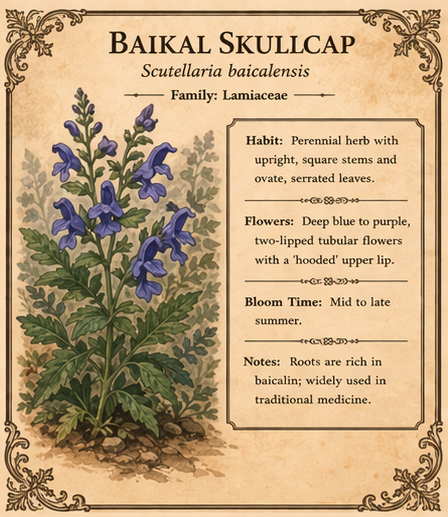
Baikal Skullcap (Scutellaria baicalensis) is a hardy perennial herb valued for its distinctive blue-purple flowers and long history in traditional East Asian herbal practices. Native to parts of East Asia, this member of the mint family develops an herbaceous clump above a substantial root system.
Its combination of ornamental flowers, perennial growth, and centuries of botanical history makes it an excellent addition to apothecary-inspired and traditional herb gardens.
Family: Lamiaceae
Genus: Scutellaria
Species: Scutellaria baicalensis
Native Range: East Asia
Growth Habit: Herbaceous perennial
Light: Full sun to partial shade
Water: Moderate
Plant Care
• Grow in well-drained soil
• Provide full sun to partial shade
• Water moderately while plants establish
• Avoid consistently waterlogged soil
• Space plants approximately 12–18 inches apart
• Established plants return as perennial growth where winter conditions are suitable
• Provide good airflow around mature plants
Germination Instructions
• Seeds may be started indoors or direct sown
• Sow shallowly in a well-draining seed-starting mix
• Keep evenly moist during germination without saturating the soil
• Provide bright light once seedlings emerge
• Maintain good airflow
• Gradually acclimate indoor-grown seedlings before transplanting outdoors
• Transplant approximately 12–18 inches apart once established
Traditional Medicinal Uses
• Baikal Skullcap has a long history of use in Traditional Chinese Medicine and other East Asian herbal traditions
• Traditionally included in preparations associated with respiratory and general wellness
• The root contains naturally occurring plant compounds, including baicalin and baicalein, that have been subjects of scientific research
• Historical use and laboratory research should not be interpreted as evidence that the plant prevents, treats, or cures disease
Interesting Facts
• Baikal Skullcap has been used in Traditional Chinese Medicine for centuries, where its dried root is traditionally known as Huang Qin.
• Unlike some other Scutellaria grown primarily for their aerial portions, the root is the part most closely associated with Baikal Skullcap's traditional herbal history.
• The plant produces attractive blue to violet, two-lipped flowers, reflecting its membership in the mint family.
• Scutellaria comes from a Latin word associated with a small dish or shield, referring to the distinctive shape of part of the flower structure.
• Its combination of botanical history and ornamental flowers makes it equally interesting for herb growers and botanical collectors.
Please Note
Baikal Skullcap should not be confused with other plants sold simply as “skullcap,” including American Skullcap (Scutellaria lateriflora). Different Scutellaria species have different histories, chemistry, and traditional uses.
For cultivation. Historical and traditional-use information is provided for botanical and educational purposes only and is not medical advice.
Ancient roots. Blue flowers. Centuries of botanical tradition growing right in the garden.