
Aeonium Species
Architectural Rosettes. Wild Color. Succulents With a Different Schedule.
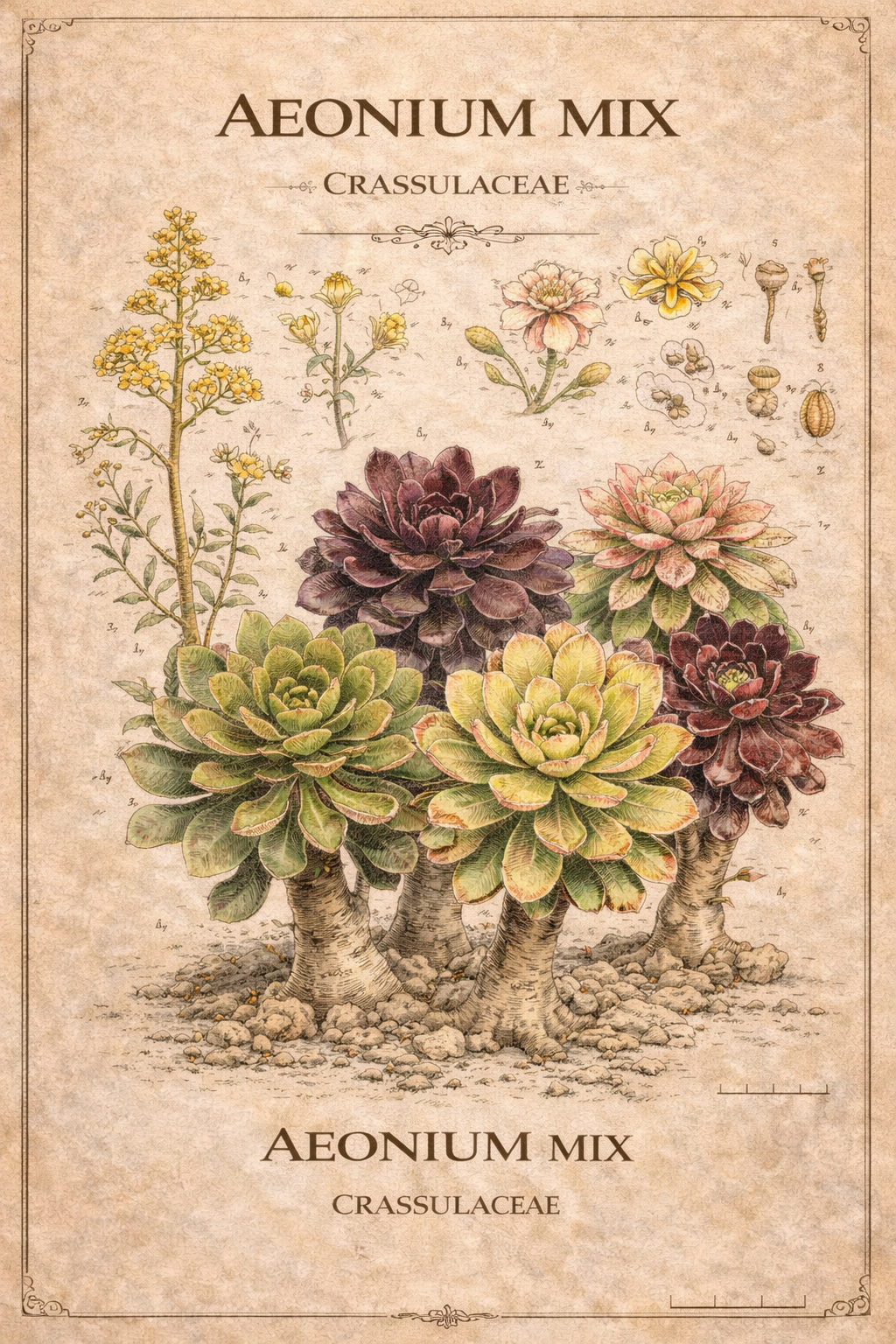
This Aeonium Species Seed Mix produces distinctive rosette-forming succulents admired for their geometric foliage, sculptural branching, and architectural form. Aeonium belongs to the Crassulaceae family and is native primarily to the Canary Islands, with species also occurring in parts of North Africa and surrounding regions.
Depending on the species, plants may develop compact ground-level rosettes, branching shrubs, or dramatic rosettes held at the ends of woody stems. Foliage can range from fresh green and yellow-green to bronze, red, burgundy, and darker tones under suitable conditions. Their striking structure and manageable growth make Aeonium especially attractive for containers, succulent collections, and mild-climate gardens.
Family: Crassulaceae
Genus: Aeonium
Native Range: Canary Islands & North Africa
Growth Habit: Rosette-forming succulent; compact to branching depending on species
Light: Bright light to full sun, depending on species and climate
Water: Moderate during active cool-season growth; reduced during dormancy
Plant Care
• Grow in a porous, well-draining succulent substrate
• Provide bright light to encourage compact rosettes and strong coloration
• Gradually acclimate plants before exposing them to intense direct sunlight
• Protect plants from extreme heat or scorching afternoon sun when necessary
• Aeonium generally perform best during mild, cooler growing conditions
• Water more regularly during active cool-season growth, allowing excess water to drain freely
• Avoid continuously wet or soggy soil
• Reduce watering considerably when plants slow or become dormant during hot summer conditions
• Provide good airflow around the foliage and root zone
• Protect plants from prolonged hard frost
• Container-grown plants can be moved to protected conditions during temperature extremes
• Branching species may eventually require larger or heavier containers as they mature
Germination Instructions
• Sow the small seeds on the surface of a fine, well-draining succulent seed-starting mix
• Gently press seeds against the surface without burying them deeply
• Cover only very lightly, if at all
• Keep the substrate lightly and consistently moist during germination, but never waterlogged
• Provide mild to warm temperatures and avoid excessive heat
• Place newly sown seeds in bright, filtered light
• Maintain gentle humidity during early germination to prevent the surface from drying too quickly
• Provide adequate airflow to discourage mold and stagnant conditions
• After germination, continue providing bright light while protecting delicate seedlings from intense direct sun
• Do not allow very young seedlings to completely dry out
• Gradually reduce humidity as seedlings establish
• Slowly increase light exposure as plants mature
• Begin allowing the substrate to dry slightly between waterings once seedlings are well established
• Transplant carefully once seedlings are sufficiently developed to handle
Interesting Facts
• Aeonium are famous for their remarkably symmetrical leaf rosettes, which can resemble large living flowers.
• The Canary Islands are the primary center of diversity for the genus, where numerous species evolved in different island habitats.
• Depending on species, rosettes may remain close to the ground or grow at the ends of branching, woody stems, creating miniature tree-like forms.
• Foliage can display shades of green, lime, yellow, bronze, red, burgundy, purple, and nearly black, depending on species and growing conditions.
• Light intensity, temperature, season, and moisture can influence foliage coloration and rosette form.
• Many Aeonium species grow most actively during cooler seasons and slow down or rest during hot summers, essentially following the opposite schedule of many familiar warm-season succulents.
• During hot or dry conditions, some species draw their leaves inward and form tighter rosettes as growth slows.
• Mature plants can produce impressive clusters of small, star-shaped flowers, commonly appearing in yellow, white, pink, or related shades, depending on species.
• Many Aeonium rosettes are monocarpic, meaning an individual rosette dies after flowering and producing seed. On branching species, however, unflowered rosettes can continue growing.
• Their compact to branching architecture makes Aeonium especially useful for container displays and mild-climate succulent gardens.
• Some Aeonium have histories of limited traditional regional use, but the genus is cultivated primarily for ornamental, horticultural, and botanical-collection purposes.
• Seed-grown plants can reveal considerable variation in rosette size, leaf shape, branching habit, coloration, mature size, and flowering characteristics.
Please Note
This is a mixed Aeonium species seed assortment. Species, seed quantities, mature sizes, rosette forms, leaf shapes, coloration, branching habits, dormancy behavior, flower characteristics, growth rates, and other traits may vary. Individual species may have different temperature, light, watering, and seasonal growth requirements. Specific species and germination results are not guaranteed.
Cool-season growers. Summer sleepers. Living rosettes with serious architectural ambition.